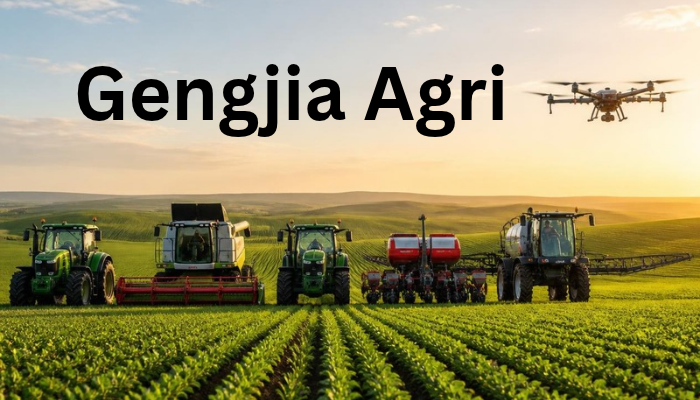
Agriculture is becoming increasingly dependent on efficient machinery to improve productivity, reduce labor requirements, and manage large farming operations. From preparing fields to harvesting crops, modern agricultural equipment helps farmers complete essential tasks with greater speed and consistency. Machinery such as tractors, harvesters, seeders, sprayers, and agricultural drones has become an important part of modern farming.
Gengjia Agri provides agricultural machinery solutions covering several important areas of farming. Understanding how different machines work can help farmers and agricultural businesses choose equipment that matches their crops, land size, and operational requirements.
The Growing Role of Agricultural Machinery
Traditional farming often requires significant manual labor and considerable time. Modern machinery allows many agricultural activities to be completed more efficiently. Equipment can be used for soil preparation, planting, crop protection, harvesting, transportation, and field monitoring.
The right machinery can also help farmers maintain more consistent working patterns. For example, precision planting equipment can place seeds at controlled intervals, while spraying equipment can help distribute crop-protection products across designated areas.
However, agricultural machinery should be selected according to actual farm requirements. Factors such as soil conditions, crop type, field size, terrain, maintenance requirements, and available operators can all affect equipment selection.
Tractors for Versatile Farm Operations
Tractors are among the most widely used machines in agriculture. Their primary advantage is versatility. Different attachments and implements can allow one tractor to perform multiple farming tasks.
Depending on the model and configuration, tractors can be used for:
- Soil preparation
- Plowing and cultivation
- Towing agricultural implements
- Planting operations
- Spraying
- Transportation
- Field maintenance
When selecting a tractor, farmers should consider engine performance, power requirements, fuel efficiency, transmission, tire configuration, operating conditions, and compatibility with existing implements.
A properly matched tractor can become the central power unit for many agricultural operations.
Harvesters for Faster Crop Collection
Harvesting can be one of the most time-sensitive stages of farming. Harvesters are designed to help farmers collect mature crops efficiently while reducing the amount of manual work required.
Different harvesting machines are designed for different crops and operating conditions. Modern harvesters may combine several processes, such as cutting, separating, and collecting crops, into a single operation.
The appropriate harvester depends on factors including crop type, field conditions, expected output, harvesting speed, machine capacity, and available storage or transportation systems.
For larger farms, efficient harvesting equipment can help reduce delays during critical harvest periods.
Seeders for More Consistent Planting
Planting quality can have a major effect on crop establishment. Seeders are designed to place seeds into the soil according to specific spacing and depth requirements.
Modern seeders can help farmers achieve greater consistency than manual planting. Depending on the equipment, farmers may be able to adjust seed spacing, planting depth, row configuration, and operating speed.
The choice of seeder should reflect the crop being planted, seed characteristics, soil conditions, and field layout.
Accurate planting can help create more uniform crop stands and make subsequent field management easier.
Sprayers for Crop Protection
Sprayers are commonly used to apply fertilizers, pesticides, herbicides, and other agricultural products. Consistent application is important because uneven spraying can lead to areas receiving too much or too little product.
Modern agricultural sprayers can provide improved control over application rates and coverage. Different configurations are available for different farm sizes and applications.
Farm operators should always follow the instructions provided for agricultural chemicals and comply with applicable safety and environmental regulations.
Agricultural Drones for Precision Farming
Agricultural drones have introduced another approach to field management. Equipped with suitable cameras, sensors, or spraying systems, drones can support several agricultural activities.
Depending on their configuration, agricultural drones may be used for:
- Crop monitoring
- Field inspection
- Plant health assessment
- Mapping
- Identifying areas requiring attention
- Targeted spraying
Drones can provide an aerial perspective that is difficult to obtain through ground inspection alone. Farmers can use collected information to identify variations across fields and focus attention where it is needed.
Drone technology continues to develop, making it an increasingly relevant tool for precision agriculture.
Choosing the Right Agricultural Machinery
There is no single machine that is suitable for every farm. Equipment selection should begin with a clear understanding of the operation.
Farmers can consider several factors:
Farm Size
Small farms may require compact and multifunctional equipment, while large agricultural operations may benefit from higher-capacity machinery.
Crop Type
Different crops require different planting, maintenance, and harvesting methods. Machinery should therefore match the crop cycle.
Field Conditions
Soil type, terrain, field size, moisture levels, and accessibility can affect machine performance.
Operating Costs
Purchase price is only one part of the total cost. Fuel consumption, maintenance, spare parts, labor, and downtime should also be considered.
Equipment Compatibility
Attachments and implements need to be compatible with tractors and other machinery. Checking specifications before purchasing can help avoid operational problems.
The Importance of Machinery Maintenance
Even advanced agricultural machinery requires regular maintenance. Preventive maintenance can help identify potential problems before they cause significant downtime.
Common maintenance activities may include checking fluids, inspecting filters, cleaning equipment, examining tires, lubricating moving components, and inspecting electrical or hydraulic systems.
Operators should follow the manufacturer’s maintenance recommendations and keep appropriate service records.
Technology and the Future of Farming
Agricultural machinery is increasingly connected with precision farming technologies. GPS guidance, sensors, automation, digital mapping, and data-based field management are changing how equipment is used.
The combination of conventional machinery with digital technology can help farmers collect more information and make more informed operational decisions. Tractors, seeders, sprayers, harvesters, and drones can each contribute to a more connected farming system.
The goal is not simply to use more technology. It is to use appropriate technology where it can provide practical value.
Conclusion
Agricultural machinery plays an important role in modern farming. Tractors provide versatile power, harvesters improve crop collection, seeders support consistent planting, sprayers assist with crop management, and drones provide new possibilities for monitoring and precision agriculture.
For farmers and agricultural businesses, choosing machinery should be based on practical requirements rather than technology alone. Evaluating crop type, field conditions, farm size, operating costs, maintenance needs, and equipment compatibility can help create an effective machinery strategy.
As agricultural technology continues to develop, companies such as Gengjia Agri can serve as a resource for exploring machinery options for different stages of the farming process.